

What a holiday home in Dubai really earns for a Spanish owner or investor
· 7 min
Weigh up the tax benefits and profitability of holiday lets vs. long-term rentals.
Leticia Heres · · 3 min read

Choosing between a holiday let and a long-term rental depends on net returns, tax, costs, occupancy and how much time the owner wants to spend on management. A holiday let can generate more gross income, but it also means higher costs, more operational work and less stable demand.
Many owners wonder whether the switch is worth it, and most point to two key advantages of long-term rentals: being able to deduct 60% of the income for meeting a permanent housing need, and not being responsible for the cost of basic utilities such as water, electricity and internet.
However, the profits from holiday lets can be significantly higher than those from long-term rentals, because utility costs usually represent only a fraction of the extra income generated by letting to tourists. A model such as Flex Renting lets you alternate between types of rental to maximise those returns.
Unlike long-term rentals, holiday-let properties have expenses that are deducted in proportion to occupancy. Even if you have listed your property all year on Airbnb, Hacienda will only let you deduct expenses in proportion to the number of days on which there have been guests.
Below we explain the expenses you can deduct in full and those that can only be deducted based on the occupancy you had that year.
The main difference between holiday and residential rentals lies in being able to deduct up to 60% of the net return in the latter case, an advantage not available to holiday-let properties because of their temporary nature.
To assess profitability, let us look at an example that shows how holiday-let income can almost double that of a long-term tenancy, a common situation with this kind of switch.
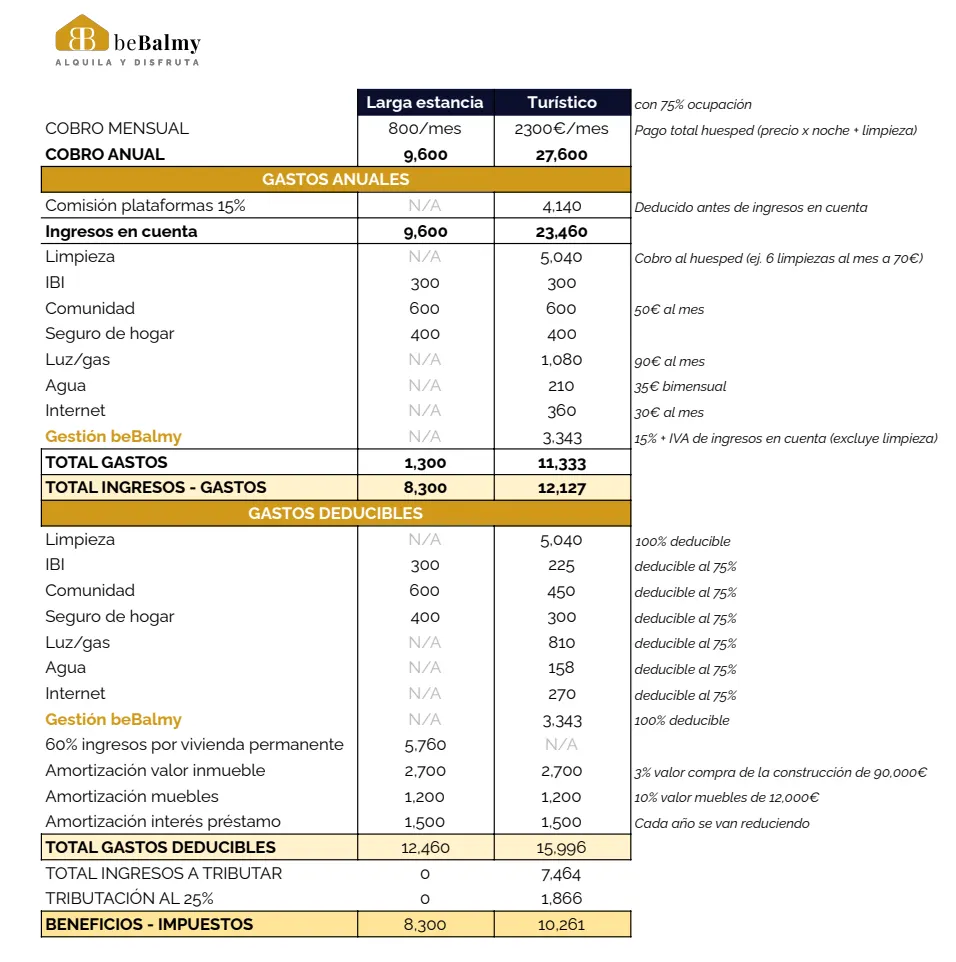
In the holiday rental industry, it is clear that, although the associated costs may be higher than with a long-term rental, it is important to stress that these extra costs rarely exceed the additional profits this type of accommodation offers. This underlines the notable advantage and appeal of holiday lets, as they also let the owner use the property and have it available whenever they need it. So, although a holiday let may at first seem to involve a higher outlay, the cost-benefit balance generally favours this option, making it a more advantageous and satisfying choice.
In conclusion, when considering the move from a long-term rental to a holiday let, it is essential to assess whether the additional profits outweigh the increased costs and, if you opt for a holiday let, keeping a detailed record of all receipts and invoices during the year will let you make the most of the tax deductions available. This is easier to manage if you first compare professional management vs managing it yourself for your holiday apartment.
Are you thinking of turning your property into a holiday let? Contact us through this form, or send us a WhatsApp message.
Unlike long-term rentals, holiday-let properties have expenses that are deducted in proportion to occupancy. Even if you have listed your property all year on Airbnb, Hacienda (the Spanish tax agency) will only let you deduct expenses in proportion to the number of days there have been guests.

We tell you what your property could earn, what needs work first and what we take off your hands. Free, with no commitment.