

I bought an apartment in Dubai: how holiday letting works
· 7 min
To let your property as a holiday rental in Madrid, it is important to understand the legislation in force and comply with it to avoid possible fines
Leticia Heres · · 5 min read

Holiday-let legislation in Madrid combines regional and municipal requirements. The Comunidad de Madrid requires the CIVUT, the declaración responsable (a sworn statement of compliance) and registration as a tourism business; in the city of Madrid you must also check planning compatibility and obtain the relevant municipal permit depending on the location and type of building.
In Spain, to begin with, there is no national law regulating holiday letting across the whole country; instead, each autonomous region has the power to regulate this activity in its territory if it wishes. In addition, some aspects of holiday letting are in fact controlled by town councils or local governments, so you need to know the legislation of the region and the town where your property is located well, to avoid administrative fines and make sure your holiday-let property meets every requirement. If you want the overall picture before going into the detail for Madrid, take a look at the holiday-let licence in Spain.
If your holiday-let property is in Madrid you are in luck, because in this article we are going to focus on the main legal aspects affecting properties in the capital. What is more, as a company specialising in holiday lets, our services include helping you apply for your holiday-let licence and making sure your accommodation is up to date.

The most recent legislation passed in Madrid on holiday-let properties is the Plan Especial de Hospedaje (Special Accommodation Plan), in force since March 2019, whose main aim is to prevent tourist overcrowding in the city. The PP (Partido Popular) government was going to amend this plan in 2022, but in the end that did not happen, so the so-called ‘Plan Carmena’ still applies. The measures it includes are:
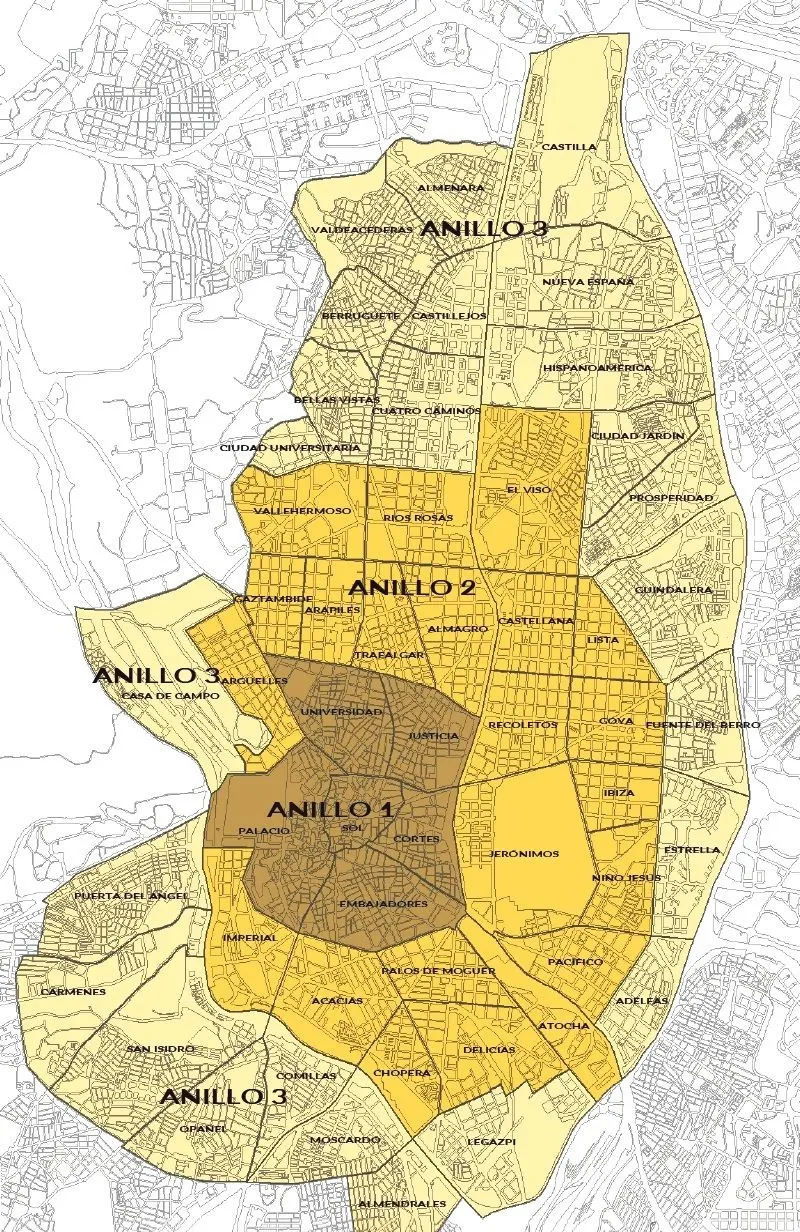
Now that the different measures are clear, it is important to know how one ring differs from another so that you do not make mistakes when choosing a flat:
Owners of properties in the first ring need to obtain the holiday-let licence, which requires an independent entrance to the property, separate from the shared access used by the residential homes in the building. As if that were not enough, it is also limited to ground and first floors, which makes sense if an independent entrance is required. This makes it really hard to find a legal flat in this area.
The legislation that applies is the same as for accommodation in ring 1.
In this case, owners who want to let their properties for holiday use have to follow the same rules as those whose properties are in rings 1 and 2, except for two very important points: you do NOT need an independent entrance and it can be on any floor, except in buildings where other commercial uses such as offices or shops are no longer allowed.

The new requirements introduced by Madrid's Plan Especial de Hospedaje have a direct impact on more than 10,000 properties used as holiday lets that cannot meet them, because many are in residential buildings where there is no way of adding an independent entrance.
In fact, when the law was passed, this meant that 95% of all holiday accommodation in the city could no longer carry on with its holiday-let activity. In addition, to make sure the legislation is complied with, the town council carries out regular inspections of accommodation that can result in fines. The single national register that was also required from 2025 is no longer compulsory: the Tribunal Supremo (Spain's Supreme Court) struck it down in May 2026, as we explain in what changes after the Supreme Court ruling.
However, despite this ‘worrying’ situation for the sector, in practice the new regulation does not seem to have had such a negative impact and, in fact, in 2019 the number of holiday-let properties in Madrid grew by 19%. Moreover, in 2022 only 250 properties held the mandatory licence and 50 were being processed, according to official sources at Madrid City Council's Área de Desarrollo Urbano y de Vivienda (Urban Development and Housing Department), which means that of all the properties still being offered as holiday accommodation, less than 2% comply with the legislation in force.
Even so, as we said, the government does not appear to have any intention of changing the legislation and will carry on with inspections.
If you own a property in Madrid and want to offer it as a holiday let for more than 3 months a year, it is important that you get to know the current legislation and check whether the accommodation meets the mandatory requirements for the ring it is in. If it is a requirement for your property, make sure it has an independent entrance or, if it does not currently have one, that adding one is a viable option.
It is also a good idea to review changes in the legislation regularly so you are always up to date and can act quickly before an inspection comes round. Not sure where to start? Do not worry: you can see the steps to follow to get your holiday-let licence in Madrid, or contact us using this form and we will help you understand the current situation of your property.
The new requirements introduced by Madrid's Plan Especial de Hospedaje have a direct impact on more than 10,000 properties used as holiday lets that cannot meet them, because many are in residential buildings where there is no way of adding an independent entrance.
If you own a property in Madrid and want to offer it as a holiday let for more than 3 months a year, it is important that you get to know the current legislation and check whether the accommodation meets the mandatory requirements for the ring it is in. If it is a requirement for your property, make sure it has an independent entrance or, if it does not currently have one, that adding one is a viable option.
We tell you what your property could earn, what needs work first and what we take off your hands. Free, with no commitment.